Early detection and management of corn rust diseases can protect your yield potential. While common rust rarely requires treatment in commercial hybrids, southern rust can significantly impact yields if left unchecked. Understanding the differences and knowing if and when to apply fungicides is crucial for protecting your investment
Background and History of Southern and Common Rust
Common and Southern rust are obligate parasites requiring a living host to survive on. Due to this they do not overwinter in central corn-growing areas. Instead, their lightweight aerodynamic spores are carried in fast low-level air streams from the Gulf of Mexico to the Great Plains each year. Significant numbers of spores can move hundreds of miles in a single day, allowing them to re-establish in the Midwest in June and July. While common rust typically isn’t of economic concern in commercial corn hybrids, southern rust can seriously impact susceptible hybrids. The impact on yield potential from southern rust is dependent on how early infection occurs, the severity of the infection, and how far up in the canopy the infection moves.
Recent Years with Excellent Conditions for Southern Rust Development in Corn Belt
Southern rust emerged as a significant and widespread concern during the 2024 and 2025 growing seasons across the Central Corn Belt. This followed several years of minimal economic impact. However, ideal weather conditions facilitated early infections, substantially increasing disease severity.
ID Guide: How to Tell Southern Rust from Common Rust
Since Common rust doesn’t typically cause economic damage, it’s important to be able to differentiate it from the more economically damaging southern rust. Symptoms of both pathogens are usually heaviest in the post-tassel stage, but there are key differences that can help you diagnose them.
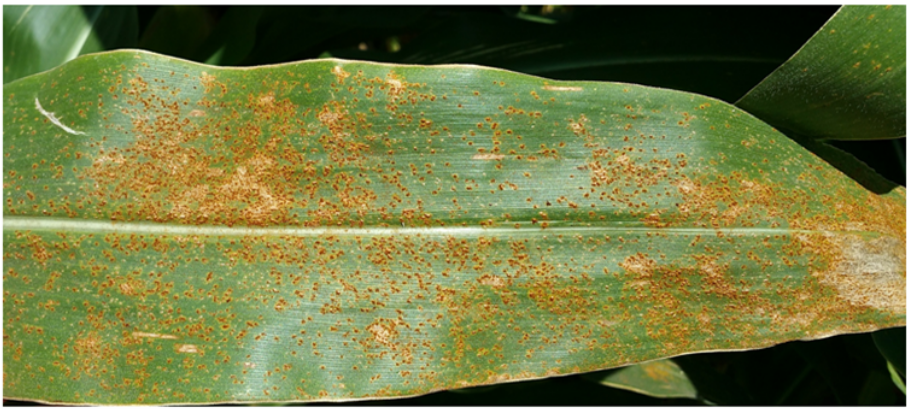
Figure 1.Southern rust pustules on upper corn leaf surface, differentiating it from less damaging common rust, which forms on both sides of leaves
Signs of Southern Rust:
- Light orange/brown pustules
- Appears only on upper surface of leaf
- Densely packed, small clusters
- Also appears on stalks, husks and sheaths
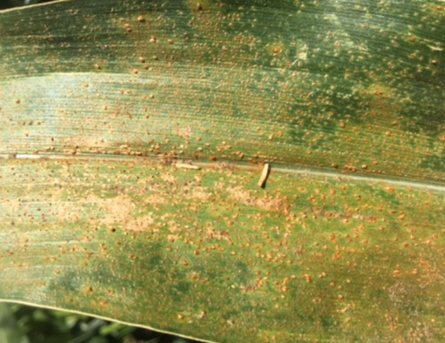
Figure 2. Common rust on upper corn leaf surface
Signs of Common Rust:
- Appears on both upper and lower surfaces of leaves
- Brownish-red circular lesions
- More spread out
- Lesions are 1/4-1/8" in length with yellow halos around edges
- Turns black late season
Know Your Hybrid's Risk Level
If Southern or Common Rust is a concern in your area, it's important to select a hybrid with a strong rating for those diseases. Golden Harvest® corn hybrid ratings range from 1 (best) to 9 (worst), with most falling between 2 and 5.
When Are Your Fields Most at Risk?
- Spores Rapidly Transported from South to North via Atmospheric Jet Streams
- Due to the wind-dispersed nature of the pathogens, optimal wind conditions can introduce and re-establish new rust spores from miles away in a very short period of time. Northward winds originating from coastal areas are more prone to introducing rust spores.>
- Conditions leading to earlier than normal spore introductions (such as in 2020) can lead to more severe yield loss.
- Temperature and Moisture Favorable for Disease Development
- Southern Rust is more likely to develop in temperatures ranging from 77-82° F
- Common Rust risk is higher when temperatures are 60-75° F
- Heavy dews and high relative humidity create ideal conditions for pathogens to thrive
- A pustule formed from a single spore can create thousands of new spores over a 7-14 day period when conditions are favorable
- Management Practices in Common with Southern Rust
- Above-average soil nitrogen levels
- Late-planted fields
Making the Fungicide Decision
During the season, scout fields for disease presence. If southern rust is confirmed early enough and the environmental symptoms outlined above are present, consider applying a foliar fungicide to help prevent or minimize disease. The most common fungicide timing is around R1 although applications as late as R3 (milk stage) can be beneficial when symptoms are present
Fungicide Options:
- Trivapro® fungicide at 13.7 fl oz per acre. NOTE: Delaying application can allow spores to establish and reduce yield potential.Trivapro fungicide offers residual control tassel stage through grain fill. fungicide offers residual control tassel stage through grain fill.
- Miravis® Neo fungicide at 13.7 fl oz per acre can provide up to 40 days of residual control.
- Quilt Xcel® fungicide at 10.5 oz per acre can provide up to 21-24 days of residual control
Scenario: Southern Rust is detected early in the season and temps are in the low 80s with high humidity
Risk: Potential yield loss if no action is taken
Strong>What to Consider:
- Hybrid susceptibility rating
- Growth stage
- Conducive Environment for disease development
- Disease Symptoms present
If your hybrid has a strong disease rating: You may not be at risk of significant yield loss, but consult your Golden Harvest agronomist for help deciding on fungicide applications.
If your hybrid has a lower disease rating: You may be at higher risk of yield loss and should consider planning for fungicide application or a fast consultation with your Golden Harvest agronomist
Key Takeaways:
- cout fields regularly based on conditions and your hybrid's susceptibility rating.
- The most important timing for fungicide application is at R1 (silking) if southern rust is confirmed.
- Early detection and proper fungicide timing are critical for maintaining yield potential.
For more insight and management advice on southern rust and common rust, contact your local Golden Harvest Seed Advisor or agronomist.