INSIGHTS
Red crown rot is a soybean fungal disease recently observed in Midwestern states caused by early season infection of C. ilicicola.
Key diagnostic feature is reddish discoloration of stem at soil line that may include bright, red-orange colored perithecia or reproductive structures appearing as tiny red balls.
Management options include using a seed treatment, crop rotation, controlling root nematodes, and potentially delayed planting.
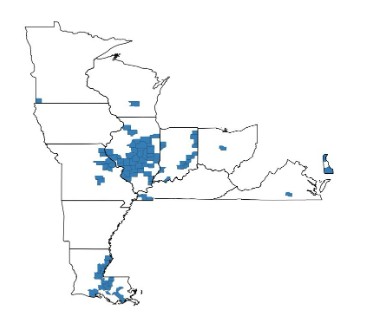 Figure 1. Red crown rot range through 2025. Map adapted from Crop Protection Network.
What is Red Crown Rot?
Red Crown Rot is a relatively newer soybean disease observed in the Midwest (Figure 1) that is caused by a soil-borne fungal pathogen, Calonectria ilicicola (anamorph: Cylindrocladium parasiticum).
First observed in Illinois in 2017
Occurs worldwide in warm temperate and tropical regions
Characterized by reddish discoloration on the crown or lower stem at the soil line, often associated with fungal reproductive structures.
The same pathogen also impacts other crops such as peanuts, ginger, and blueberries and has been found in the Southern U.S. since the 1970s.
 Image 1. Interveinal chlorosis and necrosis caused by red crown rot of soybeans. Image by A. Peterson, IL Soybean Assoc.
 Image 2. Symptomatic plant roots. Image by N. Prater, Syngenta agronomist
 How does Red Crown Rot Spread?
Once introduced to a field, C. ilicicola can persist in the soil for several years as microsclerotia
Wet spring conditions can increase the risk of infection
Red crown rot can spread within and between fields when spores move by rain splash or runoff
Spores can also travel in infested soil and crop residue moved by wind, equipment, or livestock
What conditions encourage Red Crown Rot?
Symptoms are often first noticed in poorly drained or low areas of a field. Warm, wet weather during the growing season can further increase disease development, especially when soil temperatures are between 77° and 86°F
 Figure 2. Red discoloration at soil line on a soybean stem caused by red crown rot. Image by N. Prater, Syngenta
 Symptoms
Visual signs usually appear later in the season, typically from R3 to R7
Infected plants or small patches are often scattered randomly across the field
A key diagnostic feature is reddish discoloration at the stem base near the soil line, sometimes with tiny red-orange perithecia (Image 2 and Figure 2).
Internal stem tissue may appear gray-brown, and roots may rot as disease progresses
Leaf yellowing may occur after R3; severely affected plants may senesce early while leaves remain attached.
Foliar symptoms resemble sudden death syndrome (SDS) and brown stem rot (BSR), with interveinal chlorosis and necrosis (Image 1), so both stems and roots should be inspected for diagnosis.
Later in the season, infected plants may develop yellowing and browning between the leaf veins as toxins from the pathogen move into the leaves.
Late-season identification can be difficult; submit samples to a state plant diagnostic lab for confirmation.
Management
Yield losses from red crown rot have been reported as high as 30% in soybeans1,2, warranting the need for multiple management options.
Delayed planting may help lessen the severity of red crown rot infection.
Sanitize equipment before leaving a field if there is known infection to help avoid mechanical transmission.
Managing root-damaging nematodes can help reduce root injury and potential infection sites for red crown rot.
Seed treatments labeled specifically for red crown rot have shown reductions in damage.
Victrato® seed treatment: Labeled specifically for Red Crown Rot (RCR), Sudden Death Syndrome (SDS) and multiple species of nematodes
Saltro® fungicide seed treatment: Saltro has a 2(ee) label for RCR suppression in Arkansas, Illinois, Indiana Iowa, Kentucky, Michigan, Minnesota, Missouri, Ohio, Tennessee and Wisconsin. In addition to RCR, Saltro protects against SDS and nematodes.
Product performance assumes disease presence. Performance assessments are based upon results or analysis of public information, field observations and/or internal Syngenta evaluations. Trials reflect treatment rates commonly recommended in the marketplace. All photos are either the property of Syngenta or are used with permission.
Sources:
1 Ochi, S. 2017. Studies on the epidemiology and control of red crown rot of soybean. J. Gen. Plant Pathol. 83:427-428. https://doi.org/10.1007/s10327-017-0750-7 CrossrefWeb of ScienceGoogle Scholar
2 Roy, K. W., McLean, K. S., Lawrence, G. W., Patel, M. V., and Moore, W. F. 1989. First report of red crown rot on soybeans in Mississippi. Plant Dis. 73:273. https://doi.org/10.1094/PD-73-0273F CrossrefWeb of ScienceGoogle Scholar
Syngenta supports a FIFRA Section 2(ee) recommendation for Saltro for suppression of Red Crown Rot in Arkansas, Illinois, Indiana Iowa, Kentucky, Michigan, Minnesota, Missouri, Ohio, Tennessee and Wisconsin. Please see the Section 2(ee) recommendation to confirm that the recommendation is applicable in your state. The Section 2(ee) recommendation for Saltro should be in the possession of the user at the time of application.
© 2026 Syngenta. Important: Always read and follow label instructions. Some products may not be registered for sale or use in all states or counties. Please check with your local extension service to ensure registration status. Saltro®, Victrato®, the Seedcare logo and the Syngenta logo are trademarks of a Syngenta Group Company. All other trademarks are the property of their respective owners.