Soybean Cyst Nematode Risks, Considerations and Management
Soybean Cyst Nematode (Heterodera glycines) (SCN) is the most economically damaging pathogen of soybeans worldwide, causing annual yield losses in billions of dollars. In the U.S., annual losses are typically greater than $1.5 billion and it is consistently considered to be the #1 soybean pathogen. The realized impact comes as "hidden yield loss" where plants appear healthy but produce less, making detection and management more difficult.
What is SCN and why is it a challenge?
SCN is a microscopic roundworm that attacks soybean roots, with several biological factors that make them challenging to detect and manage.
- Females form visible white/yellow cysts on roots (lemon-shaped, ~0.6mm).
- Cysts contain 200-600 eggs and can survive in soil for 8-10+ years.
- Complete life cycle ranges from 3-4 weeks under favorable conditions (68-82°F / 20-28°C).
Where is SCN most active?
SCN affects ~90% of the U.S. soybean-growing region including the North Central Region (Illinois, Iowa, Indiana, Ohio, Missouri, Minnesota, Wisconsin, Michigan, Nebraska, Kansas, South Dakota, North Dakota) which has the highest impact of any region.
However, the South Region (Arkansas, Mississippi, Tennessee, Kentucky, Louisiana, Alabama, Georgia, North Carolina) and Mid-Atlantic Region (Maryland, Delaware, Virginia, Pennsylvania) are also impacted by SCN to a lesser extent
How Did SCN Become a Widespread Yield-Robber?
Today there are many challenges regarding SCN and some alarming trends have been identified.
- Resistance erosion is highly concerning, with PI 88788 resistance declining in effectiveness and the need for diversified resistance sources coupled with limited commercially available alternatives
- Many growers are unaware of SCN presence and an estimated 50% of infested fields go undetected because symptoms are often absent or attributed to other causes.
- Warmer temperatures have led to faster nematode reproduction, and extended growing seasons can increase the number of generations per year.
- Drought stress amplifies SCN damage and is also a concern regarding climatic factors.
- Pest Management Practices adoption has been slow; only 20-30% of growers regularly test for SCN, with others over-reliant on a single resistance source along with insufficient crop rotation
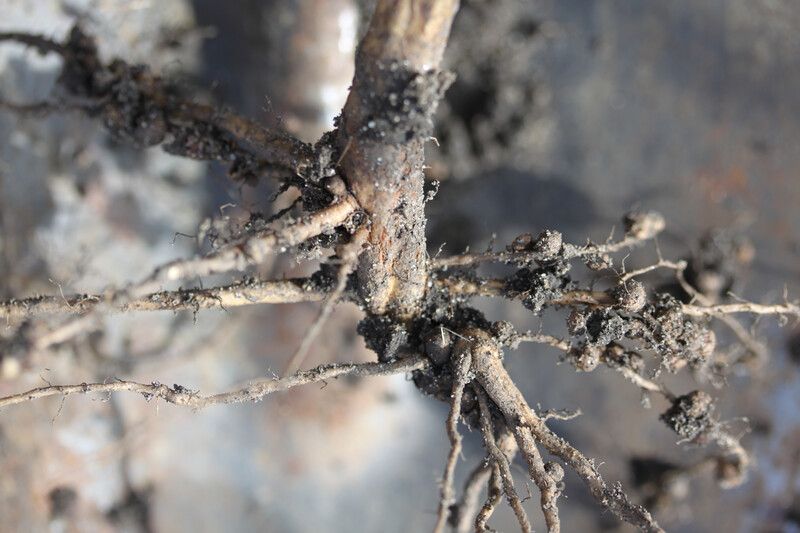 Image 2.Soybean cyst nematodes on roots.
 Identifying Symptoms of SCN Damage
Soybean plants are often asymptomatic in early stages, thus the hidden yield loss that is typically realized at harvest. Here’s what to look for:
- As the growing season progresses: stunted plants with some yellowing plants in patches.
- Poor nodulation and nitrogen deficiency symptoms.
- In dryland soybeans: Wilting during drought stress is very common.
- In irrigated soybeans: There may not be any wilting.
- By mid to late season: white/brown cysts on roots.
Five Key SCN Management Strategies
Because of the complex nature of SCN, a multi-layered plan of attack increases the odds of achieving yield protection. Here are five key management practices to keep in mind for managing SCN:
- Selecting resistant soybean varieties can be one of the most effective control methods for managing SCN. Most SCN-resistant soybean varieties are highly effective in mitigating injury and subsequent yield losses, but it is recommended to verify SCN resistance ratings for varieties being considered.
- Rotating resistance sources (PI 88788, Peking, PI 437654) is critical in the effort to prevent population shifts. Keep this in mind when selecting seed for fields with known SCN pressure.
- Crop rotation is another key management component with a minimum of 2-3 years of rotation away from soybeans. Rotate with non-host crops (corn, wheat, sorghum, alfalfa) as this potentially can reduce nematode populations by 50% per year.
- Nematicides are also highly effective and can include seed treatments like Victrato® or Saltro® seed treatments or in-furrow applications at planting. Nematicides can protect early-season root development and tend to be most effective when combined with resistant varieties.
- Soil testing is critical to determining SCN egg count population levels and sampling of fields should occur every 3-4 years in the fall. HG Type testing identifies which resistance genes are effective, thus allowing variety selection to be conducted in a more reliable manner. Cultural practices are also an integral part of SCN management and include maintaining optimal soil fertility and pH, effective control of weeds (especially legume hosts), cleaning equipment between fields, and avoiding movement of infested soil.
What is the Economic Damage Threshold for SCN?
Due to the dynamic nature of stress factors, highly specific economic thresholds based on egg counts are difficult to establish. SCN management should begin when SCN is detected, not only after a specific egg-count threshold is reached. Egg counts are useful for estimating relative population pressure, but they do not predict yield loss on their own. Weather, soil conditions, variety selection, resistance source, HG type, reproduction rate, crop rotation, plant stress, and sampling variability can all influence the final outcome. Because SCN populations can persist and increase over time, even low counts should be treated as a signal to begin proactive management and monitoring. Table 1 can be used as a rough guideline to establish a field risk level.
| Risk Level | Eggs per
100 cm3
soil | Comment |
|---|
| Low | 1-1000 | Low population. Limited yield loss anticipated if
managed actively |
| Moderate | 2,000-
10,000 | Yield loss likely if not actively managed |
| High | > 10,000 | Yield loss likely. Requires management and
recommend extended non-host crop rotation. |
| Source: NDSU How to Sample for Soybean cyst Nematode (SCN) 1 |
Sample SCN Management Scenarios
While there are many nuances involved in managing SCN to balance ROI and yield potential, these scenarios provide some ideas and guidelines to use when building out a plan.
- Population: 200-500 eggs/100 cm3
- Risk: Low
- Recommendations:
- Use SCN-resistant varieties
- Seed treatment recommended in continuous soybean
- Standard crop rotation (1:1 soybean:corn minimum)
- Retest in 2-3 years
- Population: 2,000 eggs/100 cm3
- Risk: Moderate
- Recommendations:
- SCN-resistant variety (required)
- Seed treatment such as Victrato or Saltro
- Crop rotation essential
- Consider extended rotation (2 years non-host)
- Annual monitoring
- Population: >10,000 eggs/100 cm3
- Risk: High
- Recommendations:
- Maximum protection package:
- SCN-resistant variety (rotate sources)
- Seed treatment
- In-furrow nematicide (if available/economical)
- Aggressive rotation: 2-3 years non-host crops
- Consider alternative crops if populations don't decline
- Test annually
- HG Type testing to select most effective resistance
Using HG Type Results to Select the Most Effective SCN-Resistant Varieties
All SCN populations are not equal. Different SCN populations can be more or less susceptible to any of the 7 different sources of resistance used to protect soybean varieties. The HG (Heterodera glycines) type test measures how well a specific SCN population can reproduce on each resistance source using seven “indicator lines”. Indicator lines #1: PI548402 (Peking) and #2: PI88788 are the two most common sources of SCN resistance utilized by genetic providers. The HG type indicates which genetic resistance sources an SCN population can reproduce on at 10% or greater level. For example, an HG type1.2 indicates that the SCN population being tested was able to reproduce at a rate of 10% or greater on both lines #1: PI548402 (Peking) and #2: PI88788. HG types can contain a combination of any or all of the 7 digits depending on reproduction rates on each line. For example HG type 1.2.5.7 would mean the SCN population was able to reproduce at 10% or greater rates on all four (1,2,5 & 7) lines. Since #1: PI548402 (Peking) and #2: PI88788 are the primary sources of resistance, management decisions are centered around knowing if they are present in the HG type. For example, in fields where the SCN HG type contains the #2 but not #1, soybean varieties utilizing the PI548402 Peking source of resistance would be a good choice. Likewise, SCN HG type results with #1 in it but not #2 would be well suited for planting varieties using a PI88788 source of resistance.
Key Recommendations
Choosing to ignore SCN at moderate-high levels can put your ROI goals at risk; below are some high-level recommendations for evaluating SCN risk and determining a course of action.
- Know your numbers - Test fields regularly.
- Determine HG Type - Guide Varietal Selection.
- Utilize Crop Rotation
Contact a Golden Harvest Agronomist for assistance in evaluating risk and advising on a management plan
1How to Sample for Soybean Cyst Nematode, North Dakota State University Extension, Wade Webster and Guiping Yan, 2026. https://www.ndsu.edu/agriculture/ag-hub/ag-topics/crop-production/diseases-insects-and-weeds/crop-diseases/how-sample-soybean-cyst