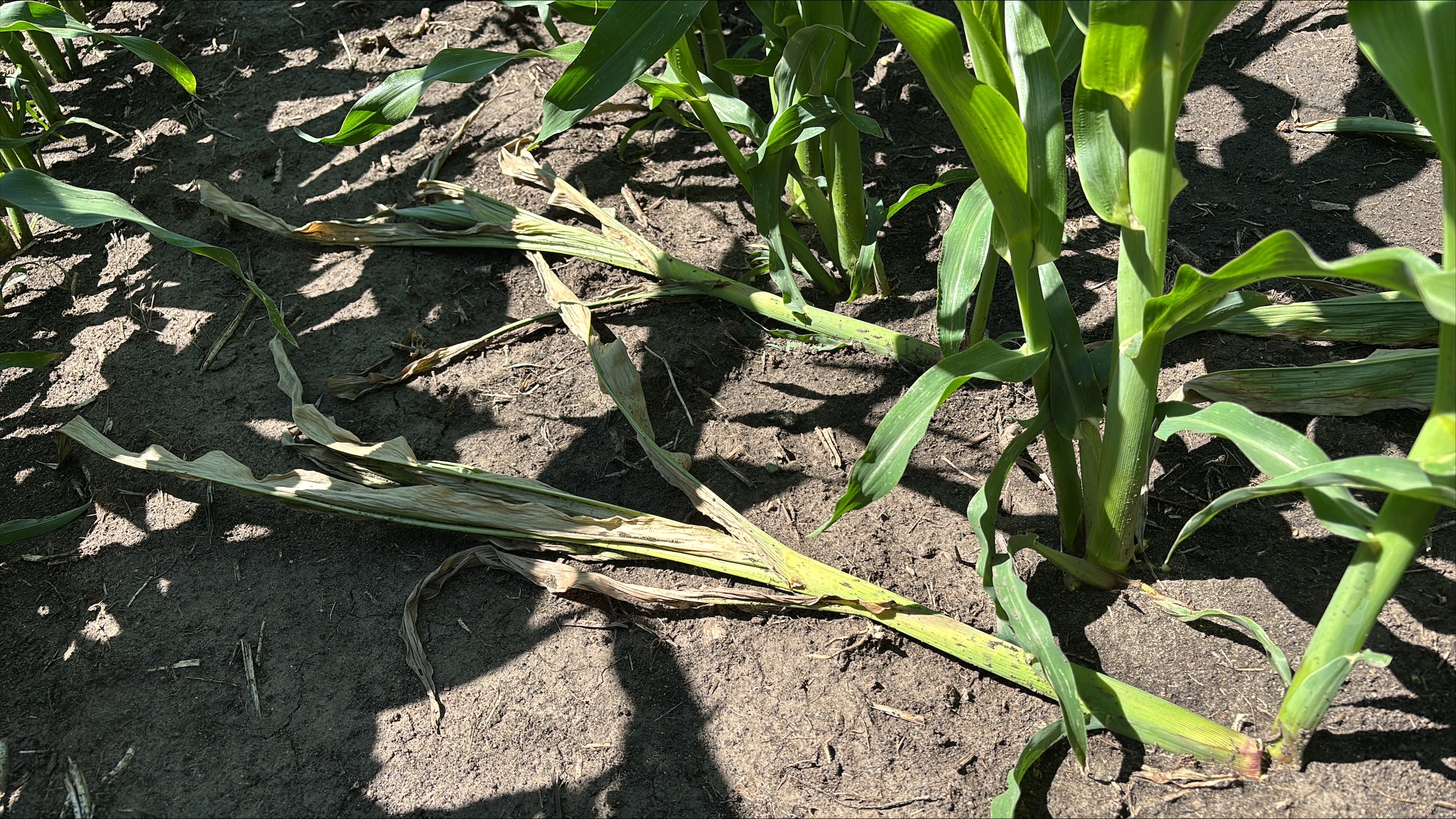
 Image 1: Wind can snap young corn near the soil surface during the V5–V8 growth stages
What is Green Snap and what causes it?
Green snap, also called brittle snap, occurs when strong winds break a corn stalk at or near a node while the plant is still green and rapidly growing. Although green snap can occur later in the season (V12-VT), this article focuses on early-season injury that occurs around the V5 to V8 growth stages. At this timing, damage can still be significant because breakage commonly occurs near the soil surface and below the active growing point. When that happens, the snapped plant will not recover into a productive ear-bearing plant.
Why V5–V8 Corn Is Susceptible
At V5, corn is entering a period of rapid growth. The growing point is moving to or just above the soil line, the nodal root system is expanding quickly, and the plant is beginning to accelerate above-ground growth. Stalk growth occurs as internode cells elongate and fill with water. During this rapid expansion, cell walls have not fully matured and structural lignin has not yet fully developed, leaving the tissue more brittle than it will be later. In the V5–V8 window, many nodes and internodes are also packed tightly together near the base of the plant, which can reduce flexibility and concentrate stress when wind pushes against the young canopy.
The result is a short but important window when the plant may be growing fast enough to be brittle, but not yet strong or flexible enough to withstand a well-timed wind event. If damaging wind arrives shortly after favorable rainfall, warm temperatures, or irrigation, plants may be growing rapidly and carrying high internal water pressure—conditions that can increase brittleness. Early-morning storms can sometimes be especially damaging because plants may be more turgid after overnight water uptake.
What Early Green Snap Means for Yield
Table 1: Estimated yield potential remaining at different levels of stand reduction. Actual yield response can vary with the extent and distribution of damage and the remaining plants’ ability to compensate.| Yield Loss from Reduced Stands1 |
|---|
| Stand Reduction (%) | Yield Potential (%) |
|---|
| 0 | 100 |
| 12.5 | 97 |
| 31 | 90 |
| 50 | 82 |
| 68 | 70 |
Plants snapped below the growing point generally do not recover, which is why lower-node breakage near the soil surface at V5–V8 should be treated as a stand-loss event rather than a temporary lodging issue. Tillers may appear after injury, but they rarely contribute meaningful grain yield. Yield impact depends on how many plants were snapped and how uniformly the damage occurred. Because V5–V8 injury happens relatively early, neighboring plants may partially compensate for lost plants by using more light, water, and nutrients later in the season. However, severe or concentrated stand loss can still reduce yield potential, especially when large areas of the field are affected. Previous seeding rate trial results can serve as a good indicator of how much yield potential remains after early green snap occurs, based on how much stand loss is anticipated.1
Why Windstorm Timing Matters When Comparing Hybrids
Hybrid genetics play a major role in green snap sensitivity. Differences in hybrids’ growth rate and early root development can influence how many days hybrids remain sensitive during rapid vegetative growth. Advanced root development may also help anchor some hybrids more firmly in the soil, making them more susceptible to snapping rather than lodging in high wind events.
Determining if damage is due to hybrid sensitivity rather than unfortunate timing can be challenging. Storm timing can make a sensitive hybrid look better—or a tolerant hybrid look worse—depending on whether wind occurs during peak brittleness. Even tolerant hybrids can snap when a strong wind event lines up with their most susceptible growth window. When comparing damage across different fields, even small differences in planting date, emergence timing, soil moisture, or growth rate can shift a hybrid into or out of the most vulnerable window. This is why green snap ratings are best interpreted as risk indicators, not guarantees of field performance in every storm.
Factors That Increase Early Green Snap Risk
- Rapid growth conditions: Warm temperatures, adequate moisture, sunlight, and strong fertility can push fast vegetative growth, which can increase brittleness.
- Recent rainfall or irrigation: Well-watered plants may have higher turgor pressure and less flexibility when wind occurs.
- Time of day: Morning wind events can be more damaging because plants are often more turgid after overnight moisture uptake.
- Growth regulator herbicides: Applications of products such as dicamba, 2,4-D, or other growth regulator herbicides near this window can increase brittleness, especially if followed by wind.
- High nitrogen availability: Strong nitrogen supply can support rapid growth, which may increase risk when paired with a wind event.
- Planting date and emergence differences: Fields or hybrids planted only a few days apart may be at different stages when a storm arrives.
- Wind severity, gusts, and direction: Stronger gusts, sudden wind shifts, and row orientation relative to wind direction can influence how much force plants experience.
- Plant size, leaf area, and leaf orientation: Larger canopies or leaf architecture that catches more wind can increase the force placed on young stalks.
- Hybrid characteristics: Differences in stalk strength, growth habit, leaf area, and duration of susceptibility can change risk.
Assessing Green Snap After a Wind Event
After a wind event, scout fields once it is safe to enter and focus on three questions: how many plants snapped, where they broke, and whether injury is scattered or concentrated by hybrid, planting date, soil type, or field area. Treat snapped plants as early stand loss, while recognizing that remaining plants can partially compensate when injury occurs this early.
When comparing hybrids, avoid drawing conclusions from one field or one storm. First compare growth stage at the time of the wind event, because small differences in planting date, emergence, soil moisture, or growth rate can shift hybrids into or out of their most vulnerable window. Golden Harvest green snap ratings provide a more reliable guide for future hybrid selection because they account for performance across many environments and wind event timings.
Looking Ahead: Reducing Green Snap Risk
To reduce future risk, use a mix of hybrids with different maturities and green snap ratings, avoid placing highly sensitive hybrids on the highest-risk acres, and be cautious with growth regulator herbicide timing when corn is approaching V5–V8 and storms are forecast.
Early-season green snap is frustrating because it often occurs in fields with excellent yield potential. Damage is usually the result of several factors lining up at once: a susceptible growth stage, rapid growth, hybrid sensitivity, and a strong wind event. Understanding that interaction helps explain why injury can vary sharply across fields and hybrids.