Skip to Main Content

Durastak Trait Technology: Taking Corn Rootworm Protection to the Next Level

Author: Syngenta Agronomist

Categories: CORN INSECT MANAGEMENT, GROWING, CORN
Share:

The battle against corn rootworm (CRW) continues to challenge U.S. corn producers, costing them up to $1 billion annually1. As this underground pest evolves and adapts, Syngenta is revolutionizing new solutions to help farmers protect their yield potential and return on investment.


Challenges with CRW

Corn rootworm has earned its reputation as one of the most devastating pests in corn production. Its below-ground feeding habits make early detection difficult, while its remarkable ability to adapt to control measures creates ongoing management challenges. The pest feeds on corn roots during early growth stages impacting standability, nutrient uptake, and overall yield potential. Environmental variability and crop rotation practices influence the level of CRW pressure, making management a moving target from year to year.

Traditionally, farmers have relied on a combination of management practices to control CRW: crop rotation, soil-applied insecticides, and traited hybrids. Rotation alone may not always be feasible, and some geographies, rotation-resistant CRW populations complicate the strategy. Adapted variants of CRW, known as western CRW variant or northern CRW with extended diapause, have changed their lifecycles to overcome single-year rotation (Figure 1).
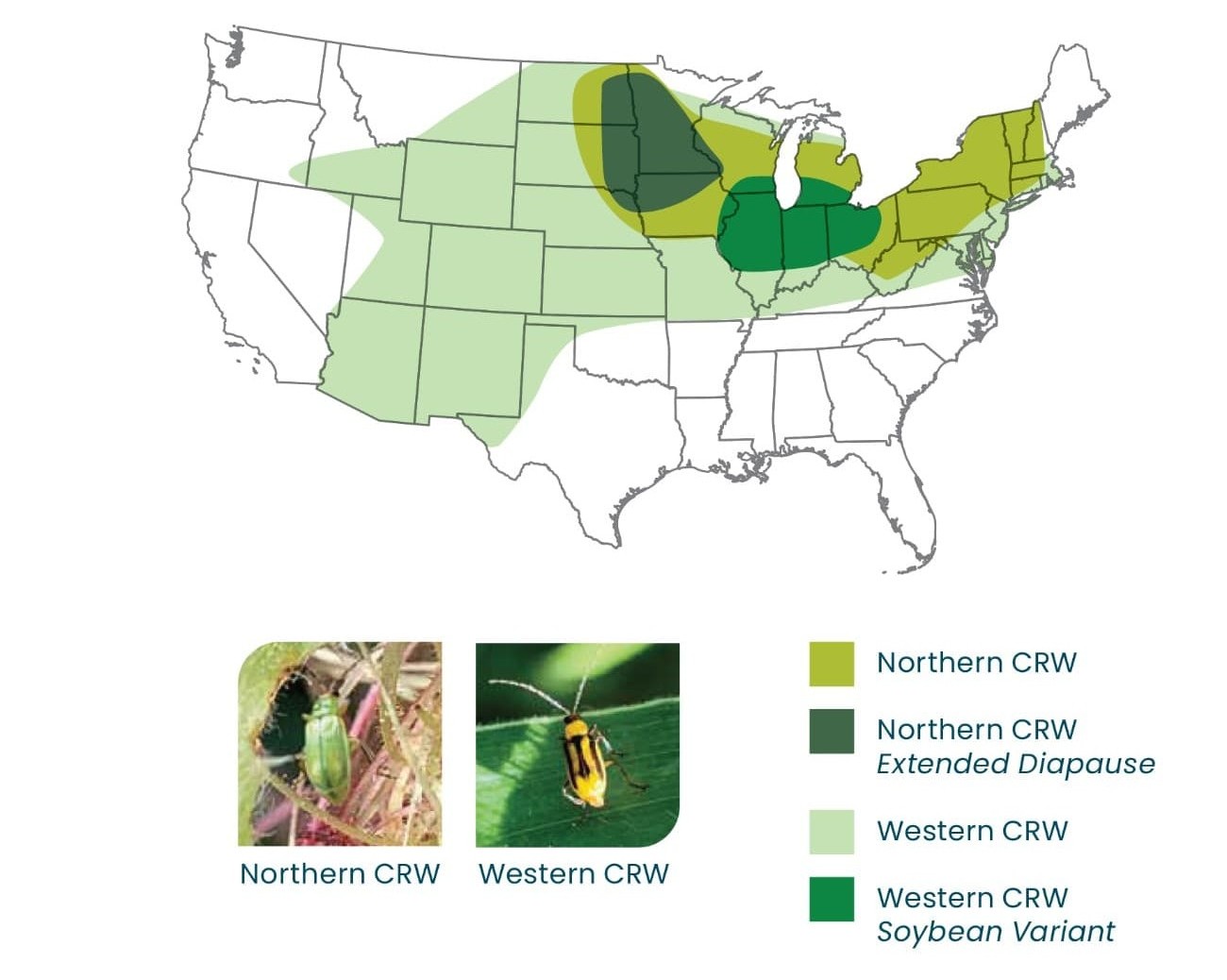
Map showing ranges of northern and western corn rootworm and their variants that have evolved extended diapause or resistance to overcome the strategy of single-year crop rotation.
Figure 1.

Soil insecticides can help, but they are rarely a complete solution, especially under high or escalating pressure. Many traited hybrids on the market today rely on similar Bt proteins. While these traits have delivered value for years, limited diversity in modes of action increases the risk of resistance over time. When the same tools are used repeatedly across acres and seasons, durability becomes a concern. Farmers are not looking for incremental improvements. They need new trait combinations and greater diversity to stay ahead of the pest long term.


Breakthrough Technology: Introducing Durastak trait technology

Durastak trait technology is the industry’s first triple Bt protein trait stack designed specifically for corn rootworm control (Figure 2). By combining three distinct, proven Bt proteins, Durastak brings a new level of diversity to rootworm management. This additional protein diversity translates into stronger and more consistent control under moderate pressure levels. It also supports resistance management by reducing reliance on the same limited set of proteins available in previous trait stacks.
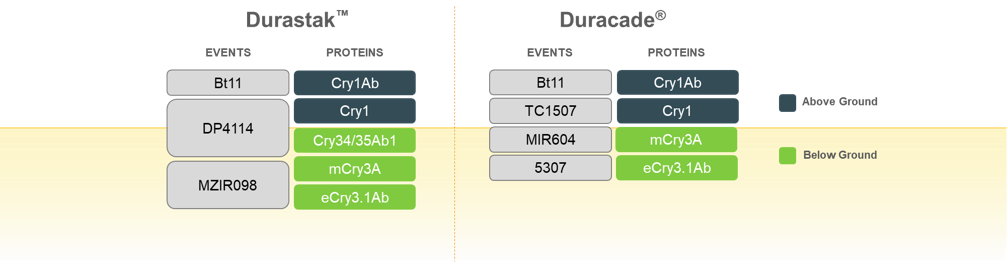
Charts comparing modes of action in Durastak and Duracade corn rootworm trait stacks.
Figure 2.

In field trials, roots remain strong and well developed, even in challenging environments. Feeding is dramatically reduced compared to untreated checks and older trait stacks. Plants stand better, remain stable later into the season, and maintain overall health through key reproductive stages. Overall, Durastak trait technology is providing 2X more nodal root protection for increased standability under moderately heavy CRW pressure2 (Figure 3).

Better root protection improves standability but also provides a stronger root system to support nutrient and water uptake during critical growth stages ultimately leading to greater yield potential. On average, hybrids with Durastak trait technology tend to yield 9.7 bu/acre greater than hybrids with Duracade® trait 2. (Figure 4)

Image showing Durastak corn hybrid roots and check non-traited corn hybrid roots, taken in Carroll, Nebraska in 2024 under heavy corn rootworm pressure.
Figure 3. Durastak (left) vs Check (Non-traited Hybrid) (right), Carroll, Nebraska, 2024, heavy corn rootworm pressure
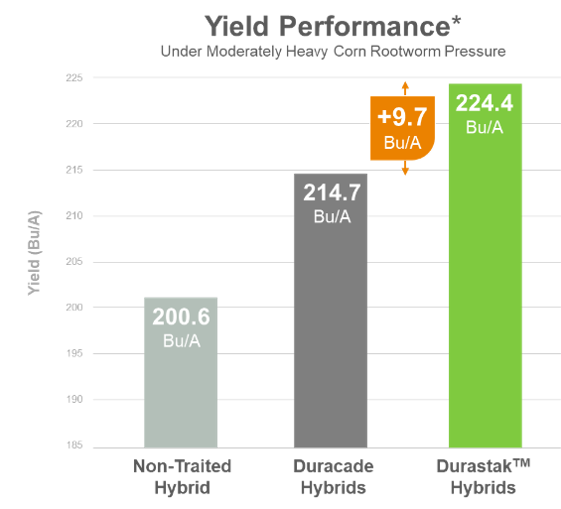
Chart showoing yield advantage of Durastak corn hybrids versus non-traited corn hybrids under moderately heavy corn rootworm pressure.
Figure 4.

Durastak helps safeguard farmer return on investment by providing next level CRW control, improved standability, and top end yield potential utilizing three power modes of action against CRW. Durstak, integrated within a long-term CRW management strategy, can deliver additional control to stay ahead of one of the most devastating pests in corn production.

Durastak Trait Technology: Taking Corn Rootworm Protection to the Next Level

Author: Syngenta Agronomist

Categories: CORN INSECT MANAGEMENT, GROWING, CORN
Share:

The battle against corn rootworm (CRW) continues to challenge U.S. corn producers, costing them up to $1 billion annually1. As this underground pest evolves and adapts, Syngenta is revolutionizing new solutions to help farmers protect their yield potential and return on investment.


Challenges with CRW

Corn rootworm has earned its reputation as one of the most devastating pests in corn production. Its below-ground feeding habits make early detection difficult, while its remarkable ability to adapt to control measures creates ongoing management challenges. The pest feeds on corn roots during early growth stages impacting standability, nutrient uptake, and overall yield potential. Environmental variability and crop rotation practices influence the level of CRW pressure, making management a moving target from year to year.

Traditionally, farmers have relied on a combination of management practices to control CRW: crop rotation, soil-applied insecticides, and traited hybrids. Rotation alone may not always be feasible, and some geographies, rotation-resistant CRW populations complicate the strategy. Adapted variants of CRW, known as western CRW variant or northern CRW with extended diapause, have changed their lifecycles to overcome single-year rotation (Figure 1).

Map showing ranges of northern and western corn rootworm and their variants that have evolved extended diapause or resistance to overcome the strategy of single-year crop rotation.
Figure 1.

Soil insecticides can help, but they are rarely a complete solution, especially under high or escalating pressure. Many traited hybrids on the market today rely on similar Bt proteins. While these traits have delivered value for years, limited diversity in modes of action increases the risk of resistance over time. When the same tools are used repeatedly across acres and seasons, durability becomes a concern. Farmers are not looking for incremental improvements. They need new trait combinations and greater diversity to stay ahead of the pest long term.


Breakthrough Technology: Introducing Durastak trait technology

Durastak trait technology is the industry’s first triple Bt protein trait stack designed specifically for corn rootworm control (Figure 2). By combining three distinct, proven Bt proteins, Durastak brings a new level of diversity to rootworm management. This additional protein diversity translates into stronger and more consistent control under moderate pressure levels. It also supports resistance management by reducing reliance on the same limited set of proteins available in previous trait stacks.

Charts comparing modes of action in Durastak and Duracade corn rootworm trait stacks.
Figure 2.

In field trials, roots remain strong and well developed, even in challenging environments. Feeding is dramatically reduced compared to untreated checks and older trait stacks. Plants stand better, remain stable later into the season, and maintain overall health through key reproductive stages. Overall, Durastak trait technology is providing 2X more nodal root protection for increased standability under moderately heavy CRW pressure2 (Figure 3).

Better root protection improves standability but also provides a stronger root system to support nutrient and water uptake during critical growth stages ultimately leading to greater yield potential. On average, hybrids with Durastak trait technology tend to yield 9.7 bu/acre greater than hybrids with Duracade® trait 2. (Figure 4)

Image showing Durastak corn hybrid roots and check non-traited corn hybrid roots, taken in Carroll, Nebraska in 2024 under heavy corn rootworm pressure.
Figure 3. Durastak (left) vs Check (Non-traited Hybrid) (right), Carroll, Nebraska, 2024, heavy corn rootworm pressure
Chart showoing yield advantage of Durastak corn hybrids versus non-traited corn hybrids under moderately heavy corn rootworm pressure.
Figure 4.

Durastak helps safeguard farmer return on investment by providing next level CRW control, improved standability, and top end yield potential utilizing three power modes of action against CRW. Durstak, integrated within a long-term CRW management strategy, can deliver additional control to stay ahead of one of the most devastating pests in corn production.

X

You are viewing from

Thank you for visiting the Golden Harvest website. We understand how important it is for you to find agronomic and product information pertinent to your local area. Please enter your zip code or select your area below to ensure you are seeing the information that matters most to you.
Learn more about regions >

CHANGE BY ZIP CODE OR SELECT YOUR REGION

OR
We're sorry. Golden Harvest is not available in this area. Please try another zip code or contact a Golden Harvest Seed Advisor for more information.

Is this page helpful to you?

How can we improve
this page? (optional)

Can you tell us your
role in agriculture? (optional)

Thanks for the feedback.

We appreciate your participation