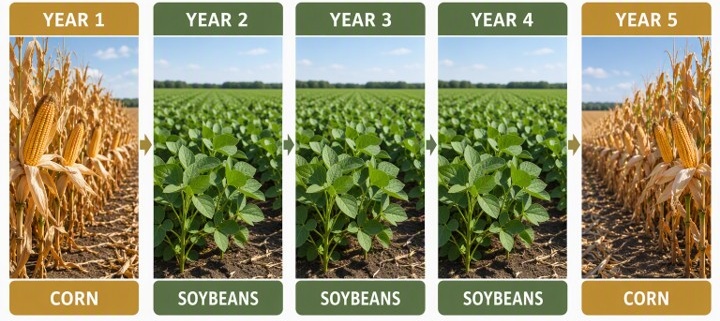
 Figure 1: Example five-year sequence: corn in Year 1, soybeans in Years 2–4, then corn in Year 5. This illustrates a three-year continuous soybean phase between corn crops.
Continuous soybeans—planting soybeans in the same field year after year— has long been thought to have severe yield penalties. However, if yield losses can be managed, continuous soybeans could offer lower input costs and economic flexibility when nitrogen prices or corn margins are tight. Accomplishing this will require intensive management to combat rising pest and disease pressures.
Is Continuous Soybean Yield Penalty Decreasing?
Previous research published in 2017 looking at the practice of growing soybeans continuously reported a 10.3% yield penalty1. Researchers also stated that the penalty continuously worsened with consecutive years and was most severe in high-moisture areas. However, recent multi-year Iowa State University research has challenged this by showing minimal or no statistically significant yield drag in certain managed trials, especially when incorporating cover crops2. Newer study results may indicate that shorter consecutive year soybean rotations may not be as sensitive to yield loss as first thought.
While continuous soybeans still require careful management, the greatest penalties may not always appear immediately in years two or three, especially when pest and disease pressure remains low. Better genetics, improved SCN tools, and stronger field drainage may also help limit yield drag.
There are undoubtedly risks associated with growing continuous soybeans, but if managed correctly there are also benefits such as lower input costs, less exposure to fertilizer price volatility and competitive advantages over corn when corn economics are weakened.
Continuous Soybean Margins Compared to Rotated Corn
Continuous soybeans are not automatically more profitable than rotated corn, but the margin gap can narrow quickly when corn fertilizer, fuel, and operating costs rise. Under favorable soybean prices, consecutive soybeans may provide a lower-input alternative that preserves gross revenue potential while reducing exposure to high corn production costs. The opportunity is strongest on well-drained, lower-risk fields where yield drag can be managed. The chart below shows how rising soybean prices can quickly narrow — and eventually overcome — the margin advantage of rotated corn when corn input costs are elevated.
Continuous Soybean Versus Rotated Corn Margins During High Input Costs
| Soybean Price | Continuous-Soy Margin | High-Cost Corn Margin | Advantage |
|---|
| $11.50 | $189 | $251 | Corn +$62 |
| $12.00 | $217 | $251 | Corn +$34 |
| $12.50 | $245 | $251 | Nearly equal |
| $12.61 | $251 | $251 | Break-even |
| $13.00 | $273 | $251 | Continuous soy +$22 |
| $14.00 | $329 | $251 | Continuous soy +$78 |
| Based on 2027 planning assumptions of 215 bu/ac corn, 65 bu/ac soybeans, $4.75/bu corn, and indicated soybean prices. Base costs were estimated at $952/ac for corn and $701/ac for soybeans using USDA ERS and Analysis by American Farm Bureau Federation for 2027 input costs. High-cost corn assumes increased fertilizer, fuel, and operating costs (+$100/ac), while continuous soybeans assume a smaller input cost increase (+$60/ac). Actual profitability will vary with grain prices, yields, crop insurance, land costs, and local input pricing. |
Pest Management Considerations
Disease, SCN, Insects and Weed Management Considerations
Continuous soybeans increase reliance on soybean-specific pest management because pathogens, nematodes, insects, and weed escapes are not disrupted by crop rotation.
Disease:
Watch for higher presence of soil- and residue-borne threats:
- Sudden Death Syndrome (SDS)
- Phytophthora
- Pythium
- White mold
- Brown stem rot
- Frogeye
- Red Crown Rot
SCN:
Continuous soybeans can accelerate SCN population growth, especially where resistance sources are repeated. Most commercial SCN-resistant varieties use the PI 88788 source, however Peking sources varieties are now more commonly introduced.
Insects:
Scout for early-season and in-season pests, including Bean leaf beetle and Soybean aphid. Bean Leaf Beetles can also vector Bean Pod Mottle Virus (BPMV), causing significant yield loss in early-infected plants.
Weeds:
Repeated soybean acres increase selection pressure for herbicide-resistant weeds and Soybean's delayed canopy requires strong residual control options. Recommended program essentials:
- Start clean with tillage or burndowns
- Use full-rate pre-emergent residual herbicides
- Use herbicides with multiple sites of action
- Apply post-emergence to small weeds
- Rotate herbicide modes of action frequently
Nutrient Management Considerations
Without corn in the rotation, fertility planning should rely on current soil tests rather than assuming carryover from previous fertilizer programs. Use soil-test recommendations, recent crop removal, and realistic yield goals to maintain P, K, and pH in the optimum range.
Key Principles
- Maintain soil pH in the optimum range, generally near 6.2–6.5. Apply Lime when pH is less than optimum.3,4
- Soil test regularly; annual testing is preferred in continuous soybean acres or fields trending lower in P, K, or pH.
- Do not shortcut potassium; soybean removes substantial K, and low K can reduce stress tolerance before visual symptoms appear.
- Consider inoculant as low-cost insurance, especially where nodulation history is uncertain, soil pH is low, or environmental stress (flooded soils etc.) may limit biological N fixation.
Residue Management Considerations
Soybean residue is typically easier to manage than corn residue, but it still deserves attention in continuous soybean systems. For soybeans residue, the priorities are slightly different than managing corn:
- Even Residue Spread at harvest to set up for good planting conditions and create good residue-to-soil contact to help microbial activity break down soybean stems and leaves.
- Use light tillage only where needed to help size residue and speed up microbial breakdown of residue-borne disease that may carry over to next season.
Management Tools
1. Variety and SCN Source Selection
In continuous soybeans, genetics carry more weight because rotation is no longer breaking pest and disease cycles. Rotate genetics, SCN resistance sources, and herbicide traits to reduce selection pressure. Avoid planting the same variety in the same field in consecutive soybean years, since repeated genetics can leave the field vulnerable to the same disease weaknesses. Selecting varieties with a different SCN resistance source each season, such as moving from PI 88788 to Peking where available, can also help slow nematode adaptation and reduce selection pressure.
2. Seed Treatment Selection
Continuous soybean acres often carry greater risk from early-season diseases, nematodes, and insects. For that reason, seed treatment decisions should focus on matching product activity to the field's expected pressure rather than relying on a minimal or generic treatment. A strong seed treatment program helps protect the stand and should be built around the pests most likely to threaten continuous soybean fields. Two options that fit pest pressure of continuous soybean rotations well are CruiserMaxx® APX and Victrato® seed treatments.
| Product | Active Ingredient | Primary Soybean Pest Targets |
|---|
CruiserMaxx® APX
(fungicide-insecticide Premix) | Thiamethoxam | Bean leaf beetle, Seedcorn maggot, Early aphid pressure |
| Fludioxonil | Fusarium, Rhizoctonia, seed-borne diseases |
| Mefenoxam | Pythium, Phytophthora |
| Picarbutrazox | Pythium, Phytophthora |
| Sedaxane | Rhizoctonia seed decay, seedling blight, damping-off |
| Victrato® | Cyclobutrifluram | Plant Parasitic Nematodes (SCN, Root Knot, Reniform Lesion & Lance), Sudden Death Syndrome Suppression of: Red Crown Rot. Early season suppression of: Frogeye leaf spot, Septoria Brown Spot & Target Spot. |
Bottom Line
The economics of continuous soybeans can be attractive when corn input costs are high, but profitability depends on managing the biological pressure that builds without rotation. Field selection, variety choice, seed treatment, and weed control all need to be intentional, not routine.
Four Keys to Success
- Rotate management yearly – Genetics, SCN resistance source, disease trait package, and herbicide modes of action. Repeating what worked last year is selecting against you.
- Know your SCN egg counts before you commit to continuous beans on any field.
- Invest in the full seed treatment program that covers continuous soybean pest risks.
- Manage weed control aggressively. Start clean, use full-rate pre-emergent residuals with multiple sites of action, apply post-emergence to small weeds, and rotate herbicide modes of action.
Final Field-by-Field Checklist
Not every field is a candidate for continuous soybeans. Before you make the call, run through this checklist.
SCN
- ☐ SCN soil sample pulled this season
- ✓ Egg counts below 2,000/100 cc good option
- ✓ Higher counts need a SCN resistance source and nematicide
- ✓ Consider rotating to corn if greater than 10,000
- ☐ Variety selected uses a different SCN resistance source than last year
- ☐ Seed applied nematicide
Disease
- ☐ Variety with:
- ✓ Strong SDS tolerance rating
- ✓ Has PRR resistance with Rps genes matched to local race profile
- ✓ White Mold tolerance in geographies where risk is present
- ☐ Seed Treatment options considered
- ✓ CruiserMaxx® APX for early-season protection
- ✓ Victrato® for SDS and Red Crown Rot root infection suppression
Fertility
- ☐ Soil test completed
- ☐ Soil pH confirmed at 6.2-6.5
- ☐ Potassium replacement rate budgeted at full crop removal
- ☐ Consider if Inoculant is needed
Weeds
- ☐ Burndown program planned
- ☐ Pre-emergent residual with at least two effective sites of action selected
- ☐ Herbicide mode of action rotated from last year's program
- ☐ Post-emergence plan in place for 2-inch application timing on waterhemp and Palmer
Sources:
1 Seifert, C. A., Roberts, M. J., & Lobell, D. B. (2017). Continuous Corn and Soybean Yield Penalties across Hundreds of Thousands of Fields. Agronomy Journal, 109(2), 541-548.
2 Archontoulis, S., Freitas, C., Licht, M., & Castellano, M. (2026). Optimizing Continuous Soybean Production. Iowa Soybean Research Center Project Final Report. https://iowasoybeancenter.iastate.edu/files/inline-files/SoySoy_Final22026_0.pdf
3 University of Illinois Extension, Agronomy Handbook — Soybean Fertility Management
4 University of Missouri Extension, Fertilizing Soybeans (MU Guide G9181).