What is Soybean Desiccation?
Soybean desiccation has traditionally been more common in regions where growers need to accelerate harvest or prepare for a subsequent crop. However, interest in the practice has grown across the Midwest as producers look for ways to improve harvest efficiency, manage green stem issues, and create more uniform harvest conditions.
While soybean desiccation is not a fit for every acre, it can provide value in specific situations. Understanding what desiccants can and cannot accomplish is critical when determining whether the practice can improve efficiency and profitability on your operation.
Why Consider Soybean Desiccation?
Many soybean growers have never used a desiccant because soybeans often mature naturally before harvest conditions become challenging. In years with favorable fall weather, desiccation may offer little measurable value. However, several situations can increase its potential return on investment.
Desiccation can help accelerate plant drydown, allowing harvest to begin sooner or creating an earlier opportunity to establish a cover crop or double-crop system. In operations managing large soybean acreages, even a few days of harvest advancement can improve labor and equipment utilization.
Beyond harvest timing, desiccation can improve overall harvest efficiency. Fields affected by green stems, late-season weed escapes, or uneven maturity frequently harvest more slowly and can create difficulties maintaining consistent combine performance.
Potential benefits of soybean desiccation include
- Accelerating crop drydown
- Improving harvest logistics
- Facilitating earlier cover crop establishment
- Reducing interference from late-season weeds
- Managing green stem issues
- Improving crop uniformity at harvest
- Reducing shatter risk caused by highly variable field maturity
The greatest value generally occurs when desiccation helps prevent harvest inefficiencies or quality losses that would otherwise occur.
Understanding Green Stem Syndrome
One of the most common reasons growers consider soybean desiccation is the presence of green stems near harvest.
Green stem syndrome occurs when the vegetative portions of the soybean plant remain green after pods and seeds have largely matured. The condition can make harvesting more difficult because combines must process tough, green plant material despite mature grain.
Factors contributing to green stem development
1. Nutrient Supply Exceeds Reproductive DemandGreen stems are often observed when the plant continues supplying nutrients and carbohydrates to stems and leaves after seed development requirements have been met. Research has shown similar responses can be mimicked by removing young pods to eliminate nutrient uptake into developing seed. This demonstrates the relationship between reproductive sinks and vegetative tissue persistence. |
2. Environmental StressEnvironmental stresses during reproductive development can trigger pod abortion. When pods are lost, the plant may be left with excess carbohydrates and nutrients that can no longer be effectively utilized for seed fill. This imbalance can contribute to delayed stem senescence and greener stems at harvest. |
3. Variety CharacteristicsVarieties differ in their tendency to exhibit green stems. Some genetics may naturally maintain stem greenness longer than others, especially under certain environmental conditions. Because green stems often increase harvest difficulty without necessarily affecting grain moisture, many growers look to desiccation as a tool to improve harvestability rather than accelerate grain drydown itself. |
Soybean Desiccant Options
Beyond harvest timing, desiccation can improve overall harvest.
Several products are commonly used as soybean desiccants. Each functions differently and includes specific use requirements, pre-harvest intervals (PHI), and harvest restrictions. Common desiccant options include:
Paraquat
Paraquat provides rapid burndown of green plant tissue and has historically been one of the most widely used soybean desiccants. Because paraquat-containing pesticide products are classified by the EPA as Restricted Use Pesticides, it is important that growers carefully read and follow all label directions and safety requirements.
Saflufenacil (Sharpen®)
Saflufenacil offers desiccation activity while also providing control of certain broadleaf weeds. Product labels should always be consulted for proper timing and pre-harvest intervals.
Sodium Chlorate (Defol® 5)
Sodium chlorate has been used extensively as a soybean desiccant and was the product utilized in the 2025 Golden Harvest evaluation discussed below.
Regardless of product selection, growers must pay close attention to labeled application timing and pre-harvest intervals. Products with longer PHIs require additional planning because delayed harvest can increase the risk of overly dry pods and harvest shattering losses.
Evaluating the Value of Soybean Desiccation: 2025 Golden Harvest Trials.
To better understand when soybean desiccation provides value, Golden Harvest Agronomy conducted field trials during 2025 at locations in Malta, Illinois, and Waterloo, Nebraska. The objective was to determine how application timing impacted yield, grain moisture, and harvestability.
Trial Design
The study evaluated two indeterminate soybean varieties:
- GH2674E3 BRAND
- GH2626XF BRAND
Sodium chlorate (Defol® 5) was applied at 4.8 qt/A for desiccation treatments.
Three treatment timings were compared:
- Untreated check (no defoliant)
- R6 (at full pod set)
- R6.5 (when seed detached from pod wall)
Questions the Study Was Designed to Answer
The trial focused on several practical questions commonly asked by soybean growers:
- Does soybean desiccation affect yield?
- How late must growers wait before applying a desiccant safely?
- Does desiccation accelerate grain drydown?
- Can desiccation reduce green stem issues?
- Under what circumstances does desiccation provide economic value?
What Did We Learn?
Early Applications Can Reduce Yield
Applications made at R6 reduced soybean yield by approximately 4.3%. This demonstrates how applying a desiccant before seed fill is complete can have a negative effect on yield.
R6.5 Applications Did Not Affect Yield
When applications were delayed until R6.5, yield was unaffected. At this stage, seed development was complete enough that terminating the plant did not negatively impact grain production. This highlights the importance of correct staging before making a desiccation application.
Grain Moisture Was Unaffected
It is often assumed that desiccants will accelerate seed moisture loss. However, once beans are physiologically mature, seed dry-down is driven mostly by weather-temperature, humidity, sunlight, and rainfall. Even though desiccated treatments harvest was delayed until the same time as untreated checks were harvested at, desiccation did not create a measurable grain moisture difference.
Green Stem Reduction Was Observed
The most noticeable benefit occurred with green stem management. Plots treated at R6.5 growth stage showed a reduction in green stems compared to untreated areas, creating a more harvest-ready crop appearance and potentially improving overall harvest efficiency.
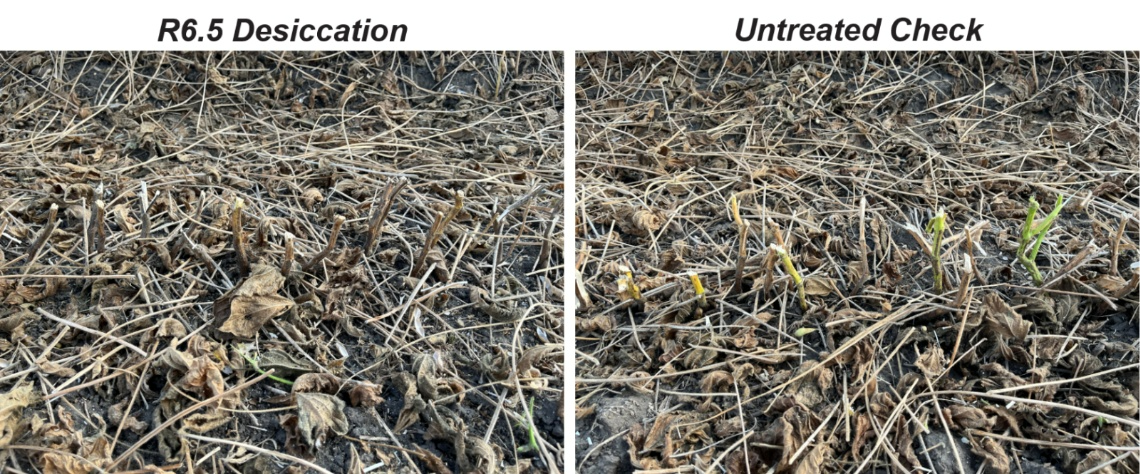 Photo of R6.5 Defol 5 application vs. untreated check from 2025 Golden Harvest Trials.
Practical Takeaways for Growers
Soybean desiccation should be viewed as a management tool rather than a standard practice for every field.
The 2025 Golden Harvest research supports several key conclusions:
- Applications made before R6.5 carry risk of yield loss.
- R6.5 applications may reduce green stem incidence without sacrificing yield.
- Hot and dry conditions at maturation may reduce the value of desiccation.
- Economic return depends on whether harvest losses or inefficiencies can be prevented.
Bottom Line
Soybean desiccation can be an effective harvest management tool when used for the right reasons and at the correct growth stage. While it may not consistently improve grain drydown or increase yield, properly timed applications can help alleviate green stem challenges, improve harvest efficiency, and create more uniform field harvest conditions.
As with any harvest aid decision, success depends on matching the practice to the field's specific challenges, understanding product restrictions, and accurately identifying soybean growth stage before applications.
All photos are either the property of Syngenta or used with permission.
Performance assessments are based upon results or analysis of public information, field observations and/or internal Syngenta evaluations.
Product performance assumes disease presence.